

................................................................................................................................................................................................................................................................................................................................................................................................................................................................................................................

Copyright © visitindia.org.in. All Rights Reserved.

Built by the warrior Chandela dynasty that rose to power in Central India between the 10th and 11th centuries the 25 odd surviving temples display different facets of life, including the sensual. These erotic carvings on some panels have given rise to much speculation since Khajuraho's re discovery by a British officer in 1838. To preserve it for posterity, Khajuraho has been declared a World Heritage Site and is among the promient destinations on the world tourism map. Despite a pastoral setting, Khajuraho has a well developed tourist infrastructure. A good example of how a non descript village turned into a success story through government and private initiative.
Khajuraho temples were built in a hundred years, from 950 to 1050 AD. Only 22 of the 85 original temples, have survived the ravages of time. Each temple stands on a high platform. There are three main parts in each temple, the entrance(ardhamandapa), assembly hall(mandapa)and sanctum(garbha griha). The temples were constructed during the reign of the Chandela Rajputs. A dance festival is held here in March every year.
Travelogues/Travel Logs of Roadtrips
Hit the road with the summary guides of our trips to various places in India. Any information feel free to drop a mail at info@visitindia.org.in


Get online driving directions, route guides, weekend planners, and customised itineries. Check out a few of our favorite user road trips, then start an adventure of your own.....Explore India by Road



Find us :-
 (Custom) (3).png)
Khajuraho
Fairs & Festivals
Apart from the seasonal Hindu festivals, a monthly fair is held on every amavasya (moonless night). A baazar selling consumer items is set up. Entertainment includes tribal dances and puppet dances. People bathe in the Shivsagar lake and worship at The Matangeshwar temple. People from neighbouring villages also attend providing local flavour, colour, fun and games.
Khajuraho Dance festival
An annual event held every evening for a week. Renowned classical dancers perform in an open air auditorium with the western group of temples forming the inspiring backdrop.
Shivratri
This festival is usually in March to worship Lord Shiva. Devotees come from far away to worship at the Matangeshwar temple. A 10 day long baazar is held where traders from all over the state display their traditional wares and handicrafts. a rural circus. folk theatre, magic shows and merry go rounds ass to the fun.


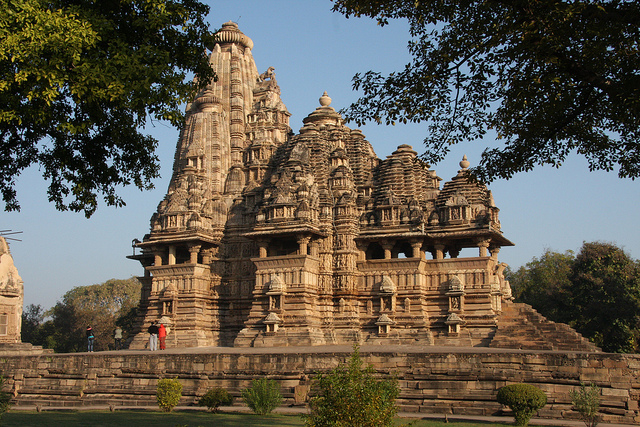
Kandariya Mahadeo
This is the largestof the Khajuraho temples and is dedicated to Lord Shiva. It is 31 metres high. The sanctum has a Shivling and the main area depicts carved statues of various gods, goddesses, apsaras.
Chaunsat Yogini
This is the oldest temple in the group(900 AD) and is made of granite. It is dedicated to Goddess Kali. Devi Jagdambe temple is another Kali temple.
Chitragupta Temple
This temple is dedicated to the Sun God, Surya and faces East. There is a 5 feet high statue of Sun driving a chariot in the temple.
Vishwanath Temple
There is a three-headed image of Lord Brahma in this temple. A statue of the bull of Shiva, Nandi faces the temple.
Lakshamana Temple
Dedicated to Lord Vishnu the temple also represents the holy trinity of Brahma, Vishnu and Shiva with Goddess Lakshmi, Vishnu's consort.
Matangeshwara Temple
It is dedicated to Lord Shiva. There is an eight feet high Shivlinga here.
Parsavanatha Temple
This is the largest temple in the Eastern group of Jain temples. The Parsavanath image in this temple, was installed in 1860. Inside the temple there is a throne facing the bull emblem of first tirthankara, Adinath.
Ghantai Temple
There is an ornately carved frieze in this Jain temple depicting the 16 dreams of Mahavira's mother, and a Jain goddess perched on a winged Garuda(Eagle).
Adinatha Temple
This Jain temple is dedicated to the Jain Tirthankar, Adinatha, and has sculptures of yakshis adorning the walls.
The other three Hindu temples are the Brahma temple, the Vamana temple and the Javari temple.
Duladeo Temple
Dedicated to Lord Shiva, the temple has sensuous statues of the apsaras besides other sculptures.
Chaturbhuj Temple
This temple has a big statue of Vishnu.
Image www.flickr.com
Excursions from Khajuraho
Raneh falls
19 kms to the north of Khajuraho on the Ken river are famous for their seasonal waterfalls and rock formations. The attraction is a 5 kms long, 100 ft deep canyon of crystalline granite in colour shades ranging from pink and red to gray. Ken Nature Trail (22 kms) within walking distance from Raneh falls is a jungle track . Ken Gharial Sanctuary (24 kms) is at the confluence of the Ken and Khudar rivers further down Raneh falls and the Nature trails. This is home yo the long snouted gharial variety of crocodile.
Rajgarh Palace
25 kms away from Khajuraho it is developed into The Oberoi Group of Hotels as a heritage property and is a major attraction as well.
Panna national Park
25 kms away a 30 minute drive from Khajuraho is the national park. It is spread over 543 sq. kms along the eastern bank of the Ken river. There are gorges, waterfalls, and wildlife such as tigers, panthers, bears, wild boars, blue bulls, gazelles, spotted deer, black bucks and birds. The park is under the Projects Tiger Scheme.