


Keoladeo Ghana National park in Bharatpur, Rajasthan
_______________________________________________________________________________________________________________________________________________________________________________________
Travelogues/Travel Logs of Roadtrips
Hit the road with the summary guides of our trips to various places in India. Any information feel free to drop a mail at info@visitindia.org.in


Get online driving directions, route guides, weekend planners, and customised itineries. Check out a few of our favorite user road trips, then start an adventure of your own.....Explore India by Road



Find us :-
 (Custom) (3).png)

Copyright visitindia.org.in 2011-12. All Rights Reserved.

How to get to Keoladeo Ghana National Park
Base is Bharatpur. Also known as the Bharatpur Bird Sanctuary, this is one of the country's most well managed and well represented parks as far as the variety of wildlife and birdlife is concerned, it is astonishingly easily accessible, located close to the township of Bharatpur, and barely an hour;s drive from Agra, and only a little more from Jaipur. Delhi too is reasonably close. Accomodation is available within the park and on its periphery. The park is open round the year for visitors.
Today 120 species of birds nest at Keoladeo and the heron is believed to be the best in the world. Several more species are migratory visitors journeying to the park in the winters from distances as far as Siberia.
The most famous of the winter migrants is the greatly endangered Siberian crane though its numbers have reduced drastically from a few hundredsa few decades ago to barely a few birds now.
Motorised vehicles are not encouraged inside the parkand visitors navigate the narrow paths in between artifically created lakeson bicycles, cycle rikshaws or on foot. The observe the close quarters of birdlife from boats also.
Painted storks easily identifiable by their long pink legs can be seen nesting on tree tops. The entire park is a medley of sounds, fluttering wings, etc offers great view in the mornings. Spoonbills and ibises, geese and ducks, cranes, herons and egrets, storks, pelicans, flamingoes, cormorants and darters, kingfishers, blue jays, shrikes, orioles, paradise flycatchers, parakeets, eagles and harriers can be seen here.
In the years the shortage of water and poaching as effected the park a bit but still it has been able to sustain its variety of wildlife also adding in mammals and reptiles which incluse the wild boar, deers like the cheetal, black buck and nilgai, mongoose, otters, jackals, fox, hyena, hare, porcupine, the rock python, leopard, jungle cat and the fishing cat.
Sight seeing
One of the finest bird parks in the world Keoladeo Ghana National Park is a reserve that offers protection to faunal species as well, though there is no doubt that this is primarily a bird sanctuary. Once a shooting preserve for the royal family of Bharatpur the marshy swamplands were created by a maharaja who diverted water from irrigation cannals to flood the low depression creating a permanent home for the waterfowl.
Today 120 species of birds nest at Keoladeo and the heron is believed to be the best in the world. Several more species are migratory visitors journeying to the park in the winters from distances as far as Siberia.
The most famous of the winter migrants is the greatly endangered Siberian crane though its numbers have reduced drastically from a few hundredsa few decades ago to barely a few birds now.
Motorised vehicles are not encouraged inside the parkand visitors navigate the narrow paths in between artifically created lakeson bicycles, cycle rikshaws or on foot. The observe the close quarters of birdlife from boats also.
Painted storks easily identifiable by their long pink legs can be seen nesting on tree tops. The entire park is a medley of sounds, fluttering wings, etc offers great view in the mornings. Spoonbills and ibises, geese and ducks, cranes, herons and egrets, storks, pelicans, flamingoes, cormorants and darters, kingfishers, blue jays, shrikes, orioles, paradise flycatchers, parakeets, eagles and harriers can be seen here.
In the years the shortage of water and poaching as effected the park a bit but still it has been able to sustain its variety of wildlife also adding in mammals and reptiles which incluse the wild boar, deers like the cheetal, black buck and nilgai, mongoose, otters, jackals, fox, hyena, hare, porcupine, the rock python, leopard, jungle cat and the fishing cat.



Spoonbill
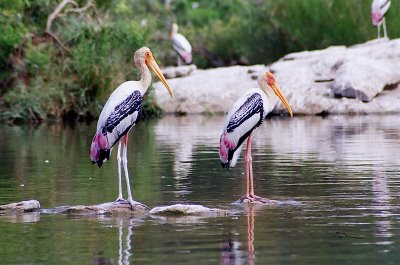
Painted storks
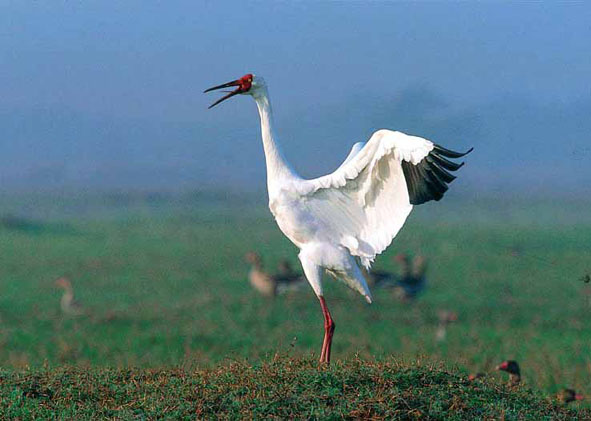
Siberian crane
Articles on Rajasthan
Other Articles on Rajasthan