


Desert National park in Jaisalmer, Rajasthan
_______________________________________________________________________________________________________________________________________________________________________________________
Travelogues/Travel Logs of Roadtrips
Hit the road with the summary guides of our trips to various places in India. Any information feel free to drop a mail at info@visitindia.org.in


Get online driving directions, route guides, weekend planners, and customised itineries. Check out a few of our favorite user road trips, then start an adventure of your own.....Explore India by Road



Find us :-
 (Custom) (3).png)

Copyright visitindia.org.in 2011-12. All Rights Reserved.

How to reach Desert National Park
Base is Jaisalmer. It is 40 kms away from Jaisalmer. Best to visit during winters. Foreign visitors may require special permission since the park is close to the Pakisthan border. A good way to view the wildlife is camping out in the desert but one must ensure that no infringement of the park is caused. One can take up activities like Jeep safari, Camping, Bonfire and Bird Watching.
Sight seeing
The vast tracts of desert sands around Jaisalmer with their wood fossils have been designated the Desert National park. To the lay person there may be little about the desert that calls for protection leave alone support wildlife. but the desert has a fragile ecosystem that has a unique variety of wildlife species. These include the somewhat ungainly great Indian bustard which because of these efforts has made a comeback in recent decades though it is still in the endangered list.
Since the sandy desert has only a few grasses and shrubs and a low scattering if indigenous trees the leaf cover is limited. This environment supports the spiny tail lizard that lives in underground colonies desert monitors that look like miniature replicas of dragons, sandfishthat swim under the sand, chameleons and ofcourse snakes that include the deadly saw scaled viper and Sind krait. Other faunal species here include the desert hare, hedgehog, the predatory Indian wolf, desert fox and the desert gerbil.
However it is with the great Indian Bustard that the Desert National Park is most closely associated especially since its conservation efforts have borne fruit. A bird that lives in small flocks it has strong legs meant for walking and feeds on everything from cereals and berries to grasshoppers locusts and even snakes. Other avifaunal species include a variety of sandgrouse, gray partridge, quails, peafowl and some insect eating birds such as bee eaters, shrikes, orioles, drongos, warblers and babblers wherever khair bushes can be found.
Special mention needs to be made of the houbara the lesser bustard which was almost hunted for extinction and which is now being allowed to breed and the desert courser which it has now been established breeds in the Thar on its migratory journey through the desert.
The Desert National Park unlike other preserves throughout the world does not overwhelm with a profusion of either vegetation or eildlife but its is precisely because of this its preservation has ensured a vital link in the ecosystem has not been destroyed. Visitors to this park need patience and preserverance to establish sightseeingsof wildlife and though they may miss the a tiger, the view of the long legged bustard cresting a sand dune is really rewarding. On a safari one gets to see plenty of Blackbucks, Desert Foxes, White cheeked bulbuls and desert wheatears and a herd of camels.


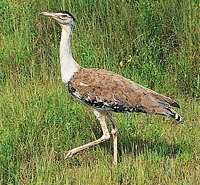
Great Indian Bustard
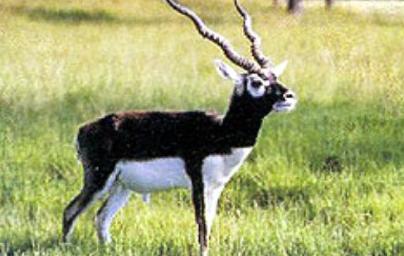
Black buck
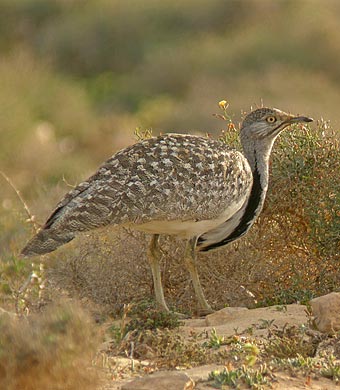
Houbara
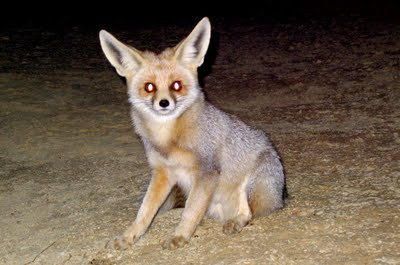
desert fox
Articles on Rajasthan
Other Articles on Rajasthan