A complete showcase on India and a in-depth focus into its culture, diversity, heritage, history and every detail to the minutest that a traveller to India would want to know. Get to know the mysterious Indian even before you get there!
Welcome to thickly forested tribal dominated state of India. Being the largest state in Madhya Pradesh, rich in minerals and having a rich forest carpet this land of tribals has preserved its naturality and tribal medicines, ancient healing science, the medicinal plants which brings natural cures to many diseases. The capital is Raipur. The wildlife polpulation of the forests is quite rich with Tiger, Leopard, Wild Boar, Cheetal, Langoor, Rhesus Monkey, Barahsinga, Sambhar, Bison, Wild Buffalo, Civet Cat and the Bear.
© Copyright 2009 visitindia.org.in
What to see in Chhattisgarh
One of the holiest rivers of India, the Narmada, is the lifeline of Chattisgarh. Amarkantak, the source of the river Narmada is full of natural beauty. The great Sanskrit poet Kalidas too has depicted the beauty of Amarkantak in his poems. Besides the source of river the garden - Mai ki Bagiya and the waterfalls - Kapil Dhara and Dugdha Dhara are worth seeing.
Amarkantak is situated in the Maikal Mountains at an altitude of 1057 m, which are the meeting point of the Vindhyas and the Satpura Mountain Ranges in Central India. It is also the source of the rivers Narmada and Sone and thus is an important pilgrimage centre for Hindus. There are dense forests of teak, Mahua, etc. around Amarkantak where one can find numerous small & trickling streams feeding the Narmada.
The holy town of Amarkantak attracts thousands of sages and devotees all through the year and therefore innumerous ashrams or religious retreats have emerged in and around this place. Nature has endowed Amarkantak with its gifts and its beautiful sylvan surroundings, picturesque ponds, cascading waterfalls and wildlife have made it a much sought after destination for the religious-minded as well as for the nature lover.
Places of Interest
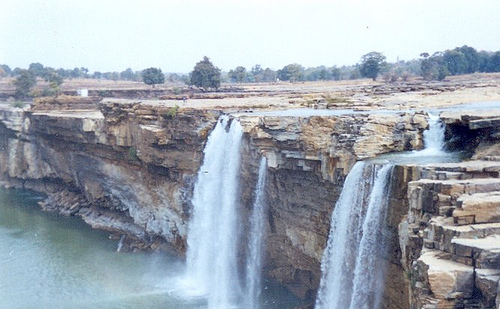
Narmada Udgam is the source of the sacred Narmada River where a temple has been dedicated to the goddess Narmada. These old temples are built in 10th and 11th centureis. Shivaratri and Nag-Panchmi, are celebrated here annually. It contains a colorfully decorated, black Basalt stone statue of Narmada. Thousands of devotees from all over the country visit the temple to pay homage to the goddess. Nearby, the Kapildhara Falls are interesting to watch as one wouldn't expect a small stream turning into a mighty river, within a few kilometers, and plunging 24m down a cliff into a gorge. The gorge is covered by dense forests and is a spectacular sight popular with picnickers. These falls are named after the sadhu or sage, Kapil, who meditated and performed extensive penance here.
Sonmuda is the source of the river Sone, also arising from the Amarkantak plateau. According to legends Sone and Narmada were to be wed, but Sone married another stream and the repulsed Narmada, changed course from east to west and vowed to remain a virgin.
The Mahadeo Hills are near Amarkantak and have been immortalized by Rudyard Kipling in his famous "Jungle Book" spreading the Indian term "jungle" all over the world. Dhuni Pani, a natural hot spring amidst the thickly wooded forests of Amarkantak is definitely worth viewing.
Dugdhdhara is another picturesque waterfall, where the water falls down a height of about 50 ft in a milky-white cascade. Mai ki Bagiya or mother's garden is an ancient temple in the well-manicured gardens. The surroundings are quite scenic and also worth a visit.
The Purans, Mahabharata, and Ramayana describe the greatness of Amarkantak. Bhrigu Kamandal, Dhuni Pani, Dugdh Dhara, Kapildhara, Mai ki bagia, Sonamuda are other sights for tourists at Amarkantak.
______________________________________________________________